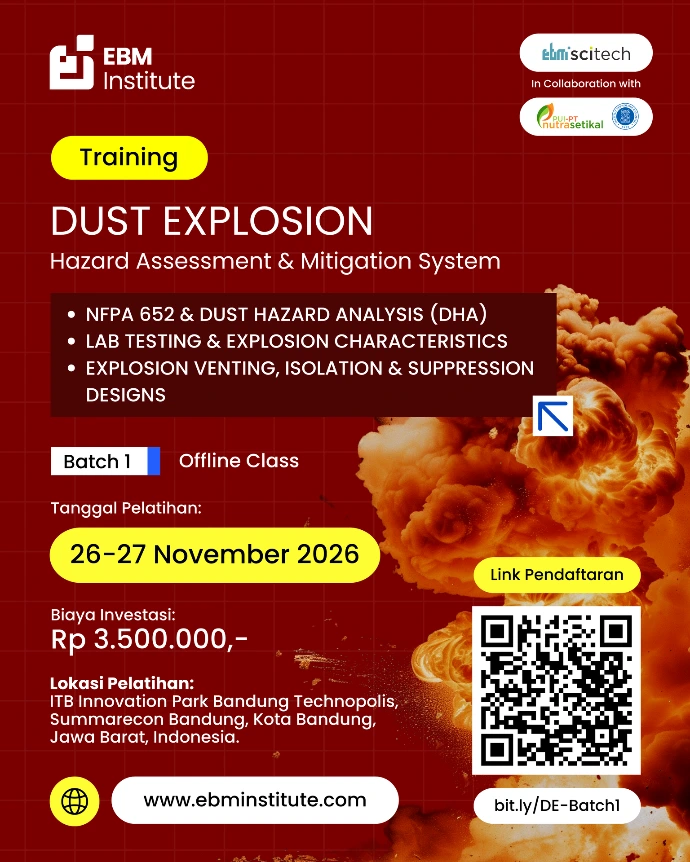
Dust Explosion Hazard Assessment & Mitigation System - Batch 1
Master the Dust Explosion Risk Analysis (NFPA 652), Design of Explosion Mitigation Protection Systems, and Secure Your Plant According to International Regulations!
Intensive Dust Explosion Training
Upcoming Schedule:
November 26-27, 2026
A risk assessment and engineering protection system for dust explosions from upstream to downstream. Learn Dust Hazard Analysis (DHA) based on NFPA 652 standards, interpretation of laboratory tests (Kst, Pmax, MIE), to the selection of venting & isolation technology.
- Comprehensive Curriculum Referencing NFPA 652 & NFPA 654
- Thoroughly Explore the Methodology of Dust Hazard Analysis (DHA)
- Guided by Experts in Process Safety & Industrial Explosions
- Hands-On Workshop: Designing Dust Safety Documents for Plants
Workshop Description:
Protect Your Assets, Lives, and Business Reputation with Reliable Dust Explosion Protection System Design
Knowing that dust in your plant can explode is just the first step. The next crucial questions are: How sensitive is the dust to small sparks? How much explosion pressure will be generated? And how do we design tank systems, silos, dust collectors, or piping networks to be safe if that explosion occurs?
Compliance with international standards such as NFPA 652 (Standard on the Fundamentals of Combustible Dust) is now a mandatory requirement for globally standardized manufacturing industries. Without a formal risk assessment, known as Dust Hazard Analysis (DHA), your plant is not only violating Process Safety principles but is also in constant danger of a major accident that could completely halt business operations forever.
2-Day Masterclass: This Dust Explosion Hazard Assessment & Mitigation System is tactically designed to provide concrete engineering solutions. Through this intensive program, you will be guided to read dust characteristics from laboratory test results (such as Kst, Pmax, MIE, MIT), classify hazardous areas (Zoning 20, 21, 22), prepare DHA documents, and design both active and passive explosion protection systems such as explosion venting, suppression, and isolation.
Register your engineering, safety, and operations management team today to ensure your plant operates safely, compliant, and free from hidden explosion hazards.
What Will You Learn?
Day 1: Dust Characterization, Regulatory Standards, & Dust Hazard Analysis (DHA)
Regulatory Standards (NFPA 652, NFPA 654, ATEX Directive): Understanding the legal framework and global standards governing combustible dust safety.
Laboratory Testing Parameters: Reading and interpreting critical parameters from dust laboratory test results: Kst (explosion constant), Pmax (maximum pressure), MIE (Minimum Ignition Energy), and MIT (Minimum Ignition Temperature).
Area Classification for Combustible Dust: Methods for determining hazardous area classification (Zone 20, 21, and 22) according to IEC/NEC standards.
Dust Hazard Analysis (DHA) Methodology: Step by step identifying hazards in each process unit (silo, grinder, dryer, bucket elevator, dust collector).
DHA Workshop: Self-directed exercise to draft a dust explosion risk assessment in a simulated plant facility.
Day 2: Mitigation Strategies, Engineering Protection Design, & Audit Readiness
Explosion Prevention Systems: Techniques for eliminating ignition sources, static grounding/bonding, spark detection, and inert gas systems.
Explosion Protection Systems (Passive & Active): Dissecting Explosion Venting technology, Explosion Suppression, and Explosion Isolation.
Housekeeping and Dust Control Design: Designing proper local exhaust ventilation systems according to industrial hygiene principles to prevent secondary dust accumulation.
Emergency Response & Safe Work Practices: Dust explosion emergency response procedures, hot work permits, and management of change (MOC).
Technical Discussion & Case Studies: In-depth analysis of design failures in protection systems during real-world dust explosion incidents.
Interactive Learning Methods
To ensure the material can be directly applied in the workplace, this workshop uses the method:
Engineering Presentations & Technical Standards: Detailed discussion on NFPA standards and their practical implementation in the plant.
Mitigation Failure Case Studies: Analyzing fatal design errors in safety equipment that led to secondary explosions.
Venting Area Calculation Simulation: Introduction to basic formulas for estimating explosion vent panel sizes.
Technical QA & Sharing Session: A direct consultation session regarding your factory layout with expert instructors.
Workshop Instructor
An industrial safety expert who will assist you.

Dr.Ing. Ir. Suhendra
Industrial & Process Safety Expert / HSE Consultant
A senior practitioner and consultant in the field of industrial safety and occupational health culture with thousands of hours of training experience. His main focus is bridging theory and field operational practice. He has experience assisting various sectors from manufacturing to energy in developing proactive safety management systems and sharp risk analysis.